Key points at a glance
- Smart Border Austria requires mandatory electronic pre-notification for transit procedures through Austrian offices of transit before the vehicle reaches the border.
- Since 1 January 2026, the obligation has applied to transit entry from Switzerland and Liechtenstein. With the end of the transition phase, it was extended from 1 May 2026 to all NCTS movements with an office of entry or office of transit in Austria.
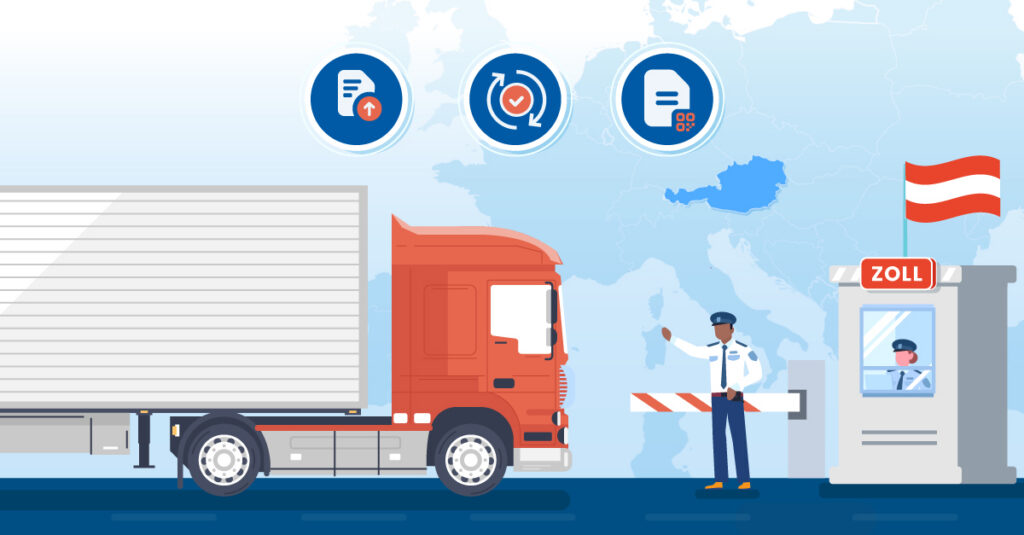
- If the data is not correctly available in the system on arrival, the vehicle may not enter the customs control zone and must turn back. A smooth connection between forwarding software and the customs interface is therefore essential.
What is Smart Border Austria?
Smart Border Austria is an application of the Austrian customs administration that digitalises customs processes in cross-border goods traffic. The project was initiated by the Austrian Federal Ministry of Finance and coordinated with the Swiss customs administration. It is the further development of the pilot project Zoll Korridorverkehr Vorarlberg.
At its core, the system replaces the previous paper-based control slip procedure with a data-driven electronic process. Relevant customs data is processed in advance, allowing goods flows to be separated from infrastructure bottlenecks, for example at heavily used clearance points in the Vorarlberg region.
This should help relieve pressure on geographical bottlenecks. Backlogs that previously disrupted individual border corridors are intended to be reduced through the digital process.
Important distinction: Smart Border Austria applies only to goods traffic. It is not the same as the EU Smart Borders package for passenger traffic, such as the Entry/Exit System.
Who does Smart Border Austria apply to and from when?
The system is relevant for all economic operators that transport goods, or have goods transported, under the transit procedure through Austrian customs offices.
The initial focus is traffic between the European Union, Switzerland and Liechtenstein through heavily used Vorarlberg border crossings such as Lustenau and Feldkirch. These have traditionally been key trade corridors between the EU and Switzerland.
Since 1 January 2026, electronic pre-notification has been mandatory for transit entry from Switzerland and Liechtenstein and is now in regular operation. For freight forwarders and carriers serving this corridor, Smart Border Austria is already part of day-to-day operations.
The key change: extension to all NCTS transit movements since May 2026
The main change came with the end of the transition phase. Since 1 May 2026, electronic pre-notifications via Smart Border Austria have been mandatory for all NCTS movements where the office of entry or office of transit is located in Austria.
This means the notification obligation is no longer limited to individual corridors. It now covers transit traffic through Austria more broadly.
For companies outside Austria, this has direct consequences. Companies dispatching from Germany or routing consignments through Austrian customs offices must integrate the pre-notification into their processes. German customs explicitly referred to this extension in a technical notice dated 6 March 2026.
Companies that continue to rely on the old paper-based process risk their vehicles not being cleared at the border.
Key dates at a glance
| Date | What applies |
| 1 July 2024 | Warenort Korridor for entry and exit in regular operation |
| 1 January 2026 | Mandatory pre-notification for transit entry from Switzerland and Liechtenstein |
| 1 May 2026 | Extension to all NCTS movements with an office of entry or office of transit in Austria |
| 13 October 2026 | Complete end of the paper-based control slip procedure |
| 1 December 2026 | Regular operation of further processes across Austria |
The transition is therefore not yet fully complete. During 2026, further border customs offices will be digitalised step by step. At the latest when the paper-based control slip procedure ends, the digital process will become unavoidable.
How does the pre-notification process work?
The process follows three clear steps.
- Submission of transit data:The economic operator submits the transit procedure data electronically to Smart Border Austria before the vehicle reaches the border.
- Validation: The system checks the information against the NCTS database and verifies that the transit procedure is valid and complete.
- Release: After successful validation, the system issues release for the defined border corridor.
For the driver, the result is practical and visible. On arrival, the driver must be able to present a barcode or registration number from the Smart Border application.
Once the border crossing has taken place, Smart Border Austria sends an electronic border crossing confirmation to the participant’s IT system. The business case is then considered closed. Cancellation is only possible as long as the border crossing has not yet taken place.
What happens without correct pre-notification?
The consequence is clear and is strictly enforced. If the data is not correctly stored in the system on arrival, the vehicle may not enter the customs control zone and must turn back. Retrospective registration directly at the border is not planned.
For freight forwarders, this creates a concrete operational risk: lost driving time, missed time slots and knock-on delays along the supply chain. In tightly planned transport operations, a single refusal can disrupt several tours.
The administrative effort therefore shifts clearly to the preparation phase. Companies that prepare the pre-notification cleanly and completely avoid expensive standstills at the border.
What does this mean technically for freight forwarders?
The central requirement is seamless integration between the company’s forwarding or customs software and the Smart Border Austria interface. The system uses a modified web service interface, the CTW WebService, which is already known from the ICS2 environment.
Companies that already handle their customs processes digitally can build on existing structures.
Beyond the technical connection, data quality is decisive. Because the system automatically checks the information against the NCTS database, incomplete or incorrect data immediately creates problems with release.
A clean and complete data basis is therefore no longer a formality. It is a prerequisite for clearance. Companies that invest in processes and interfaces secure the availability of their transports.
How should companies prepare?
Three steps are especially important.
- Review transport flows: Clarify which transports run through Austrian customs offices and therefore fall under the notification obligation. Since the extension in May 2026, the affected scope is much broader than at the start of the year.
- Connect the technology: Ensure the connection to Smart Border Austria and check the data quality in the transit procedure.
- Train operational teams: Make sure drivers and dispatch teams know that clearance is not possible without a barcode or registration number.
Many companies outsource customs handling to a specialised partner instead of maintaining their own interfaces and customs expertise.
Gerlach handles the preparation and transmission of transit data on behalf of its clients, regardless of which freight forwarder or carrier performs the transport, so the customs process runs reliably in the background.
Conclusion
Smart Border Austria marks the transition to a fully digital transit process at Austria’s borders. Electronic pre-notification is no longer an optional convenience. It is a requirement for a truck to be cleared.
With the extension to all NCTS transit movements through Austria and the approaching end of the paper-based control slip procedure, the process affects a broad range of companies in Germany, Austria and Switzerland.
Companies that adapt their processes, interfaces and data quality early can avoid refusals and keep supply chains stable. Gerlach supports companies in meeting Smart Border Austria requirements across the full transit process. Get in touch to review your current transit setup for Austria.