Key takeaways
- The importer usually stays liable for what is declared in its name, so choosing a customs broker is a compliance decision, not a procurement decision.
- Four criteria matter most: compliance, data access, reporting and expertise. Price and convenience come after them.
- Once your customs data sits in one place, you can audit it, see where duty is being overpaid and spot unused free trade agreements.
Why does choosing a customs broker matter if the importer is liable?
It matters precisely because the importer is liable. Your broker prepares and lodges the declaration, but in most countries the company the goods are declared for carries the responsibility for what that declaration says.
– What EU law says about liability
In the EU, a customs broker can act for you in one of two ways.
- With direct representation, the broker acts in your name, which makes you the declarant and the debtor of any customs debt.
- With indirect representation, the broker acts in its own name but on your behalf. In that case, Article 77(3) of the Union Customs Code makes you a debtor too.
So the customs broker may share the liability, but it never fully takes it off your hands. If a declaration is wrong, the duty and any follow-up from customs will come back to you.
– Why you know your products better than your broker
There’s a second reason. You know your bill of materials, your SKUs, what each part does and why. Your broker files what you give them. If that information is wrong, or if you never check what they file, the mistakes are yours.
That’s the shift I’d ask every importer to make: stop thinking of customs as something your broker does for you, and start thinking of it as something you own and your broker carries out.
What happens when too many brokers declare in your name?
When you have one broker, you have one way of doing things. When you have more than 150, you have more than 150 ways.
– The same part, classified differently
At my former employer, the same part was classified in different ways depending on which broker handled the shipment. We sent out instructions. Some brokers followed them. Many didn’t.
– 150 versions of the truth
Error rates were too high, and the same audit findings kept coming back. Reporting was all over the place, because every broker kept its own records in its own format.
With that many brokers across that many divisions, it was next to impossible to own the data and make sure it was correct. So we changed it.
What should you look for in a customs broker?
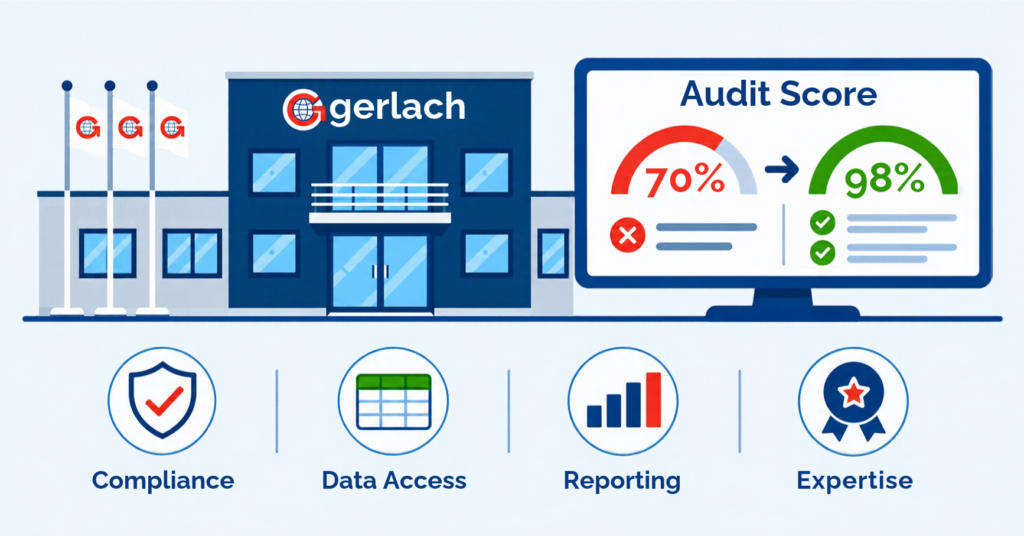
We consolidated to a handful of brokers and chose them on four criteria. Price wasn’t one of them, and neither was convenience. We treated it as a trade and customs decision first.
– Compliance: will they do it right and follow your instructions?
A good broker gets declarations right. A good broker for you also follows your classification decisions, your valuation rules and your origin data – and tells you when they think something is wrong instead of quietly doing it their own way.
Ask how a broker handles instructions you give them, and what happens when one of their declarants disagrees with your classification.
– Data access: can you see everything declared in your name?
If you can’t see what’s being declared in your name, you can’t check it. You should have access to every declaration a broker files for you: codes, values, origin, duty paid and any preferential treatment claimed.
This isn’t a nice-to-have. Without it, you only find out about errors when customs audits you.
– Reporting: can you get it at the touch of a button?
Access is one thing. Usable reporting is another. If pulling a list of last quarter’s imports by commodity code takes weeks of emails, you won’t do it often enough to catch problems.
Ask a potential broker to show you what their standard reporting looks like and how quickly you can get a custom export.
– Expertise: can they support the business as it grows?
Your business will change. New products, new markets, new suppliers, new trade rules. A broker who handles your current lanes well may not be able to advise you on a new country or a new customs procedure.
Look for a broker who can tell you not just what to declare, but why – and who flags changes before they affect you.
Why shouldn’t price decide which broker you use?
Because the cost of a cheap broker doesn’t show up on the broker’s invoice. It shows up in audit findings, in duty you overpaid and in duty relief you never claimed.
A lower fee per declaration is easy to compare. The value of getting classifications right, or of spotting an unused free trade agreement, is harder to see in a tender – but in our case it was worth far more.
What changes when you get the broker set-up right?
For us, the change was measurable.
– From below 70% to 98%
Error rates dropped massively. Our audit scores went from below 70% to 98%.
– Visibility you can act on
Once the data was in one place, we could finally see it. Auditing became a lot simpler, and we could check that what was being declared in our name was correct.
We could also see where the operation was inefficient, and where we should have been using free trade agreements and weren’t. Between savings from free trade agreements and duty recoveries, that visibility was worth millions.
None of that was possible with more than 150 brokers.
Which questions should you ask your customs broker?
Whether you have one broker or twenty, these three questions will tell you a lot.
- Do they have the expertise to support your business as it grows and expands?
- Can they give you full reporting at the touch of a button? If you can’t see what’s declared in your name, you can’t own it.
- Is it a real partnership? Do they follow your instructions, flag issues and help you improve, or do they just process entries?
If the answer to any of those is no, the problem isn’t only the broker. It’s that nobody on your side owns customs.
Own your data. Own your classifications. Own your compliance.
How can Gerlach help you keep control of your customs data?
Gerlach works as a customs broker for importers and exporters across Europe – independently of any carrier, so your declarations are handled the same way whichever forwarder moves your goods. We help companies keep their customs data consistent, visible and compliant.