Key takeaways
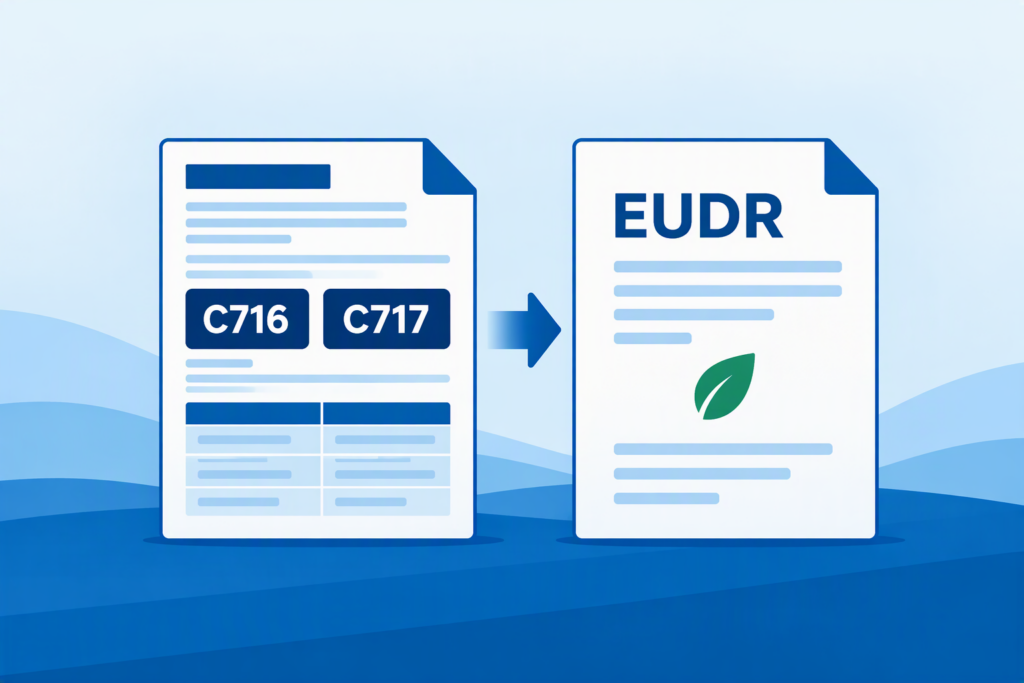
- For EUDR-relevant goods, the customs declaration must usually carry the TARIC code C716 with the due diligence statement reference number, or C717 with the simplified declaration identifier.
- Other codes apply in specific situations, for example for goods outside scope, used goods, samples, packaging, or re-imports and exports by downstream operators.
- If a required reference is missing and no other code applies, customs will not release the goods for import or export.
Why does EUDR matter for the customs declaration?
EUDR is often discussed as a supply chain and sustainability topic. For companies placing relevant products on the EU market or exporting them, it also has a very concrete customs dimension.
– Two systems, one link: the reference number
Before relevant products are imported or exported, the operator submits a due diligence statement (DDS) in the EU’s EUDR information system. The system then generates a reference number. That reference number is the link between EUDR compliance and customs: it has to be declared in the import or export declaration.
Customs authorities check this through measures in TARIC, the EU’s integrated tariff database. For goods under codes listed in Annex I, TARIC requires a document code in the declaration – either a reference to a DDS or simplified declaration, or a code explaining why none is needed.
The obligation applies when goods are released for free circulation or declared for export. Goods placed in customs warehousing or transit are not yet affected – the reference is needed at the point of release.
– What happens if the information is missing
According to the Commission’s TARIC guidance, if a DDS or simplified declaration is required but not presented, and no other applicable code applies, the import or export is not allowed after control.
In practice, this means delays, storage costs and potentially missed delivery dates. The reference therefore needs to be available before the goods arrive at customs, not after.
Which information does the customs declaration need?
In most cases, one of two TARIC document codes applies. Which one depends on who submitted the statement in the information system.
| Situation | TARIC code | What the declaration needs |
| A due diligence statement (DDS) has been submitted | C716 | The DDS reference number |
| A micro or small primary operator has submitted a simplified declaration | C717 | The simplified declaration identifier |
– C716: the standard case
C716 applies when the operator has carried out due diligence and submitted a DDS. The customs declaration must contain the DDS reference number.
One DDS can cover several customs declarations, and one customs declaration can refer to several DDS. What matters is that every relevant product in the declaration is covered by a valid reference.
– C717: simplified declarations for micro and small primary operators
Micro and small primary operators – such as smallholders producing relevant commodities themselves – can submit a simplified one-off declaration instead of a full DDS. Instead of a DDS reference number, the customs declaration then contains the simplified declaration identifier, declared under C717.
Note that C717 had a different meaning in earlier versions of the TARIC guidance. The September 2026 revision gave it a new description following the 2025 amendment of EUDR. If your internal work instructions or software settings date from 2024 or 2025, check them against the current TARIC guidance.
Which other situations require a different code?
Not every shipment of goods under an Annex I code needs a DDS. The TARIC guidance contains further codes for specific situations. In these cases, the declaration contains a code that explains why no reference is required – but the situation must actually apply and be supported by evidence.
The most relevant situations include:
- Goods outside EUDR scope under an “ex” code, for example natural gums such as balata, which share heading 4001 with natural rubber but are not covered (Y129)
- Products produced before 29 June 2023 (Y132)
- Used, second-hand, waste or recovered products that are excluded under Annex I (Y133)
- Samples and goods for examination, analysis or testing that meet the conditions of Annex I (Y187)
- Qualifying packaging materials and containers used to support, protect or carry another product (Y190)
- Goods placed on the market during the transitional period and later exported or re-imported (C718)
- Micro and small undertakings established by 31 December 2024, which benefit from the later application date – usable until 29 June 2027 (Y141)
You do not need to know every code. What matters is understanding that the correct entry depends on the circumstances of each shipment. Each code is a declaration to customs authorities – it should never be used as a default or “just in case”.
What applies to re-imports and downstream operators?
Re-imports are one of the situations where EUDR and customs interact in less obvious ways. A typical scenario looks like this:
- A company places a relevant product on the EU market – for example, natural rubber covered by a DDS.
- A downstream company buys it and sends it to a processing partner outside the EU.
- The processed product, still listed in Annex I, is later re-imported into the EU.
– Re-imports: the upstream reference becomes relevant again
When the product crosses the border again, it needs a document code once more. If the re-importer is a downstream operator, it does not have to submit a new DDS for the part that has already been covered. Instead, it declares the reference number of the original upstream statement – under C720 for downstream operators that are not SMEs and are registered in the EUDR information system, or under C725 for SME downstream operators, which do not need to be registered.
This only works if the re-importer can show that the product was previously placed on the EU market and then exported. Without that evidence, the re-import is treated like a first import, with full due diligence and a new DDS. Relevant commodities added outside the EU – for example, during processing – also require their own due diligence.
– Exports by downstream operators
When a downstream operator exports a product that has already been covered by a DDS or simplified declaration, the export declaration does not contain a reference number. Instead, a specific code is used: Y196 for non-SMEs and Y188 for SMEs. The upstream references remain in the company’s own records.
– What this means operationally
For downstream operators, the key is information management. Upstream reference numbers need to be collected when goods are purchased, linked to the relevant products and kept accessible. Evidence such as invoices, export declarations and transport documents should be retained, so that the history of the goods can be shown at the next border crossing.
If this information only sits with the purchasing or sustainability team, it is likely to be missing when the goods reach customs.
What should you clarify before your goods reach customs?
The following checklist helps you prepare before an EUDR-relevant shipment arrives at the border:
- Is the product potentially within EUDR scope? Check the product against the current Annex I, including any “ex” limitation.
- What is the correct tariff classification? The commodity code determines which TARIC measures apply.
- What is your role in the supply chain? Operator, downstream operator or trader – and SME or non-SME.
- Is the movement an import, re-import or export? Each direction can require a different code.
- Is a DDS or simplified declaration required – or does another situation apply? If an exemption code applies, make sure the evidence is available.
- Has the reference or information reached your customs broker? And has it arrived in time to be included in the declaration?
How Gerlach connects EUDR compliance with customs clearance
EUDR compliance and customs clearance are often handled by different teams. The practical risk lies in the gap between them: a valid DDS is of little use if its reference does not reach the customs declaration.
Our experts will support you with tariff classification and import and export clearance – including the correct EUDR codes and references in your declarations.