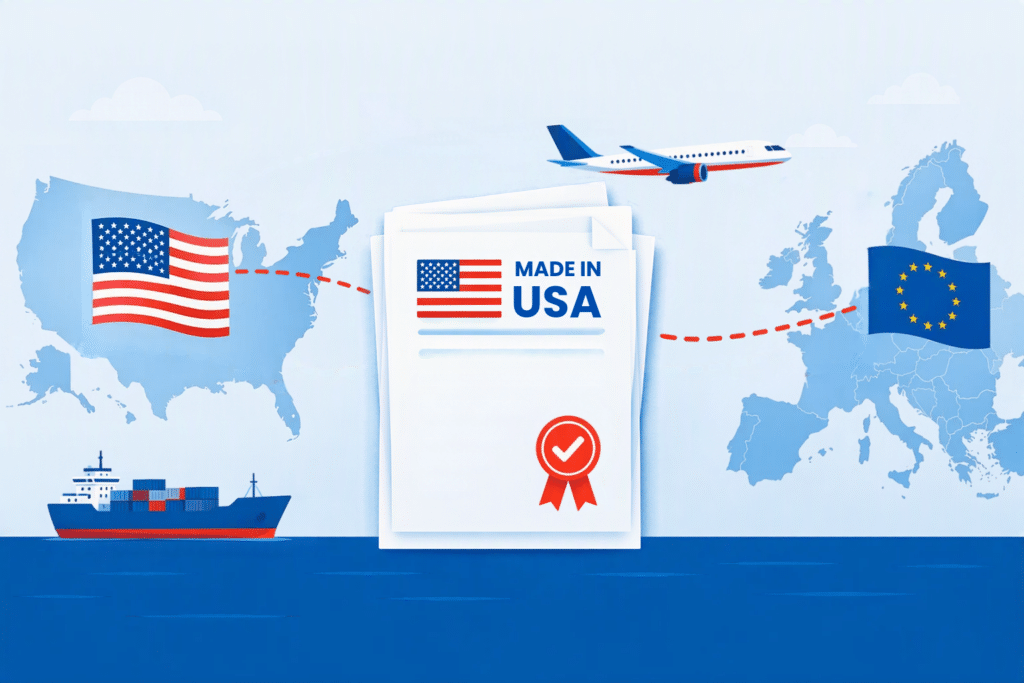
Since 1 July 2026, many goods originating in the United States enter the EU at reduced or zero duty. The legal basis is Regulation (EU) 2026/1455, which implements the EU’s tariff commitments under the EU-US Joint Statement of August 2025.
What the regulation does not provide is a clear answer to the question customs authorities will ask first: how do you prove the goods are actually of US origin? As long as that question remains unsettled, the duty saving comes with documentation risk.
What does the EU-US tariff regulation cover?
The regulation sets out which US goods benefit from lower duties and under which conditions. Understanding its scope is the first step, and it also shows where the gaps lie.
– Three annexes, three types of relief
Regulation (EU) 2026/1455 applies from 1 July 2026 to 31 December 2029. It does not introduce a blanket zero rate. Instead, relief depends on the goods’ tariff classification:
| Annex | What it provides |
| Annex I | 0% duty on a broad range of goods, including most industrial products |
| Annex II | The ad valorem duty component no longer applies; a specific duty may still be due |
| Annex III | 20 tariff quotas at 0% for certain agricultural, processed and seafood products |
Import VAT is not affected. The Commission may suspend the measures if imports cause serious injury to EU industry or if the US does not uphold its commitments.
– What the regulation leaves open
Despite being widely called an “agreement”, the measure is not a classic free trade agreement. The EU grants the reduced duties unilaterally, and no preferential rules of origin have been negotiated yet.
The regulation therefore defines which goods qualify, but not how their origin is to be determined or documented. Article 6 closes this gap with a fallback.
How do you prove US origin under the new rules?
Proving US origin involves two separate requirements: the goods must qualify as US-origin under EU rules, and they must have reached the EU by an eligible route. Both must be documented, and neither can be covered by a single standard form.
– Non-preferential origin as the fallback
Under Article 6, US origin is determined by the EU’s non-preferential rules of origin in the Union Customs Code (UCC). Goods are of US origin if they were wholly obtained there. Where several countries were involved in production, the goods must have undergone their last substantial, economically justified processing in the US.
For goods with complex supply chains, this is not always easy to establish. A product assembled in the US from imported components may or may not qualify, depending on the processing involved.
– Freedom of evidence – but an invoice is not enough
The regulation does not prescribe a specific document. The principle of freedom of evidence applies: importers may rely on any suitable documentation.
That flexibility has limits. According to the European Commission’s Q&A on the new rules, third-party documents such as “Made in the USA” markings, origin statements on invoices or certificates of origin are not considered sufficient in themselves. The certificate of origin under Annex 22-14 of the UCC Implementing Regulation cannot be used for this purpose at all.
The Commission advises importers to obtain supporting evidence from their US exporters. If that evidence cannot be provided, the reduced duties cannot be claimed.
– The additional hurdle: proof of direct transport
Implementing Regulation (EU) 2026/1422 added a new Article 59a to the UCC Implementing Regulation. Alongside proof of origin, importers must be able to show that the goods:
- were transported directly from the US to the EU, or
- remained under customs supervision while passing through a third country, and
- underwent no operations other than those needed to keep them in good condition where they were stored or split up
Direct transport requirements are familiar from preferential trade agreements. Their application to non-preferential origin is new, and it affects goods routed through hubs outside the EU in particular.
– Why practice still differs between member states
The Commission’s guidance leaves room for interpretation, and national customs administrations have issued their own instructions. Declaration requirements already vary: the EU-wide TARIC document code U190 must be declared, but some member states require additional national codes for proof of direct transport.
Which evidence authorities will accept as “sufficient” in practice is still taking shape, and approaches differ. Businesses should not rely on one country’s practice being accepted elsewhere.
Why does this matter for indirect customs representation?
The documentation burden does not only concern importers. Where a forwarder or customs broker declares goods under indirect representation, the consequences of insufficient proof extend to them as well.
– Joint liability as customs debtor
Under indirect representation, the customs representative, often a forwarder, lodges the declaration in its own name on behalf of the importer. The representative therefore becomes the declarant and, under the UCC, a customs debtor jointly with the importer.
If US origin later turns out to be insufficiently proven, the duty difference can be recovered from either party. The financial risk does not stay with the importer alone.
– The risk surfaces later – in post-clearance audits
Missing evidence is rarely detected at clearance. It typically emerges during a post-clearance audit, where customs authorities can generally notify a customs debt up to three years after it was incurred. By then, obtaining evidence from a US supplier may be considerably harder.
How can importers and representatives reduce the risk?
As long as there is no harmonised standard, the risk cannot be eliminated entirely. It can, however, be reduced considerably with consistent documentation and clear responsibilities between importers and their representatives.
– Secure transport documents from the start
Proof of direct transport should be collected with every shipment, not reconstructed later. Relevant documents include:
- bills of lading and air waybills
- purchase and transport contracts
- packing lists
- for transhipment or storage in a third country: customs documents or non-manipulation certificates
– Build origin evidence beyond the invoice
An origin statement on the invoice is a starting point, not proof. Stronger evidence combines several elements, such as supplier declarations with production details, bills of materials or manufacturing information. A certificate of origin from a US chamber of commerce can support the case, but should not be relied on as the sole evidence.
– Brief customers on their documentation duty
Representatives should inform their customers early that they must be able to substantiate US origin at any time, including in a later audit. Clear agreements on who provides which evidence reduce disputes afterwards.
– Watch for red flags in shipment paperwork
Documents that contradict the declared origin deserve a closer look: references to manufacturing in a third country, non-US supplier addresses, or unusual routings. Such inconsistencies are exactly what customs authorities look for.
Navigating proof of origin with Gerlach
Proof of origin under the EU-US tariff regulation remains an evolving compliance area. As a carrier-independent customs specialist with more than 140 years of experience, over 1,000 customs experts and offices in 27 countries, Gerlach helps importers and forwarders assess their documentation and declare US-origin goods compliantly.