Key takeaways
- The IPAFFS notification is submitted by the GB importer or their agent, but it is built on the health certificate and shipment data you provide as the exporter.
- A health certificate only stays valid if the consignment remains unchanged in transit – one reason why Gerlach moves regulated goods to Great Britain only as dedicated loads.
- Errors come to light at the border control post and can see the entire load refused entry, with substantial costs for delays, storage, destruction or return.
Which of your imports fall under IPAFFS?
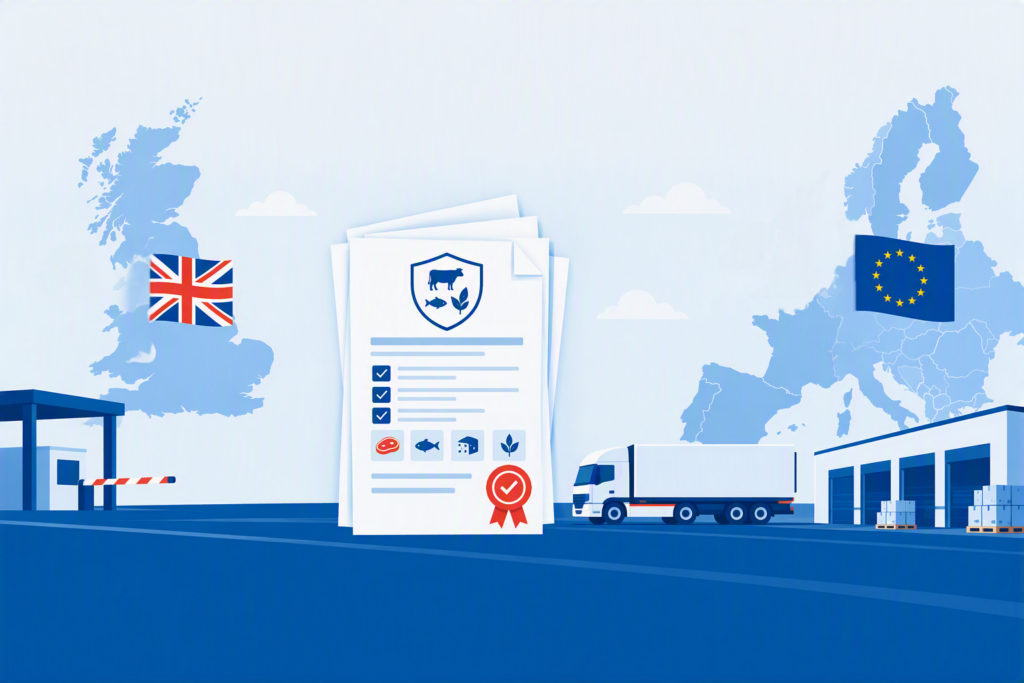
IPAFFS (the Import of Products, Animals, Food and Feed System) is the UK’s system for pre-notifying goods subject to sanitary and phytosanitary (SPS) controls. It covers:
- live animals and germinal products
- products of animal origin (POAO), such as meat, dairy and fish
- composite food products
- animal by-products (ABP)
- high-risk food and feed not of animal origin (HRFNAO)
- medium- and high-risk plants and plant products
Each commodity has a BTOM risk category – low, medium or high – which determines the certificate required and how often goods are checked.
For more information about IPAFFS and the applicable requirements, visit the official GOV.UK guidance.
Who files the notification – and what do you contribute as the exporter?
The notification is submitted by the importer or their customs agent in Great Britain. As the EU exporter, you do not use IPAFFS yourself – but you supply everything the notification is based on.
– The health certificate
Medium- and high-risk animal products need an export health certificate (EHC) from an official veterinarian; regulated plants need a phytosanitary certificate. Great Britain accepts verifiable PDF health certificates from EU member states. Send the electronic copy to your importer early – it must be uploaded before the notification is submitted.
– Consistent shipment data
Commodity codes, weights, package counts and vehicle details must match across the certificate, notification and customs declaration. Discrepancies are a common reason for holds, even when the goods themselves are compliant.
– Lead times
The official pre-notification deadlines depend on the goods:
| Goods | Minimum pre-notification |
| Products of animal origin, animal by-products | One working day before arrival |
| Plants and plant products via RoRo or air | Four hours before arrival |
| Plants and plant products via other modes | One working day before arrival |
For shipments handled by Gerlach, our UK team also needs the estimated time of arrival (ETA) and the truck and trailer details at least six hours before arrival – an internal deadline on top of the official pre-notification deadline.
Why does the way you load your goods matter?
A health certificate remains valid only if the consignment does not change on its way to Great Britain. Goods consolidated at a hub must be recertified.
Checks are made per consignment and on a risk basis. On a mixed load, however, if just one consignment is selected for inspection, the entire vehicle goes to the border control post. Gerlach therefore moves regulated goods to Great Britain exclusively as dedicated full or part loads (FTL/PTL), not on standard groupage.
– Certificates
Animal products of medium or high risk require an export health certificate (EHC) signed by an official vet in the supplier’s country; regulated plants a phytosanitary certificate. Without the electronic copy, you cannot notify – a late certificate means a late notification.
– Route and border control post
Regulated goods must enter through a border control post (BCP) designated for their commodity type. Gerlach routes these shipments via Dover or Eurotunnel, so the relevant BCP is Sevington in Kent. Eligible shipments there also incur the common user charge – whether or not they are selected for inspection.
What happens if a shipment isn’t compliant?
IPAFFS informs the notifier whether the consignment has been selected for checks. If an inspection reveals non-compliance, the border authorities may refuse entry to the entire load on the truck – and might not even allow the affected shipment to be unloaded separately. If unloading is permitted under certain conditions, the authorities may order the goods to be destroyed; sending them back is less common, but possible.
Whatever the outcome, the costs can be substantial: demurrage, storage and delays at best, destruction or return on a dedicated vehicle at worst.
Will the planned UK–EU SPS agreement change the rules?
The UK and the EU are negotiating an SPS agreement intended to remove most export health certificates and routine border checks. The UK government aims for it to take effect in mid-2027, subject to the outcome of negotiations. Until then, all current requirements remain in place.
How can Gerlach support your shipments to GB?
With more than 140 years of experience, over 1,000 customs experts and a presence in 27 countries, Gerlach supports your UK-bound shipments independently of any carrier, and customs is all we do.