Key takeaways
- You or your appointed agent submit the IPAFFS notification and remain accountable until the authorities release the goods.
- Late or inaccurate certificates and shipment data from your EU supplier translate directly into missed deadlines and holds.
- A single non-compliant consignment can see the whole truck turned away at the border – and the bill for demurrage, storage or destruction can be steep.
Which of your imports fall under IPAFFS?
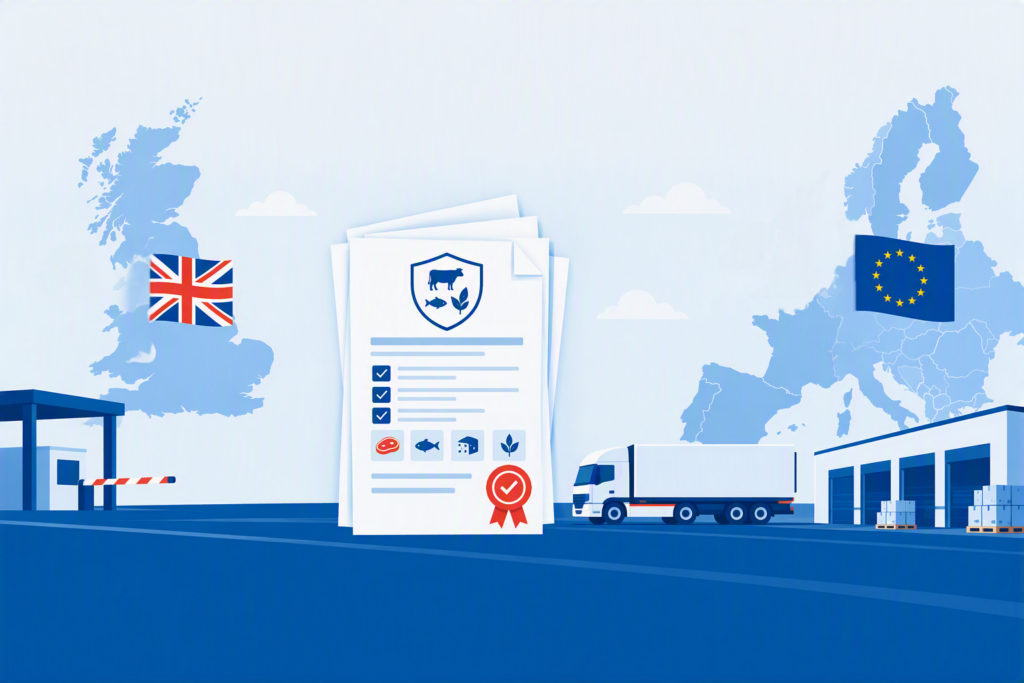
IPAFFS (the Import of Products, Animals, Food and Feed System) is where GB importers pre-notify goods subject to sanitary and phytosanitary (SPS) checks. It applies if you import:
- meat, dairy, fish and other products of animal origin (POAO)
- food products combining animal and plant ingredients (composite products)
- animal by-products (ABP) not intended for human consumption
- food and feed not of animal origin classed as high risk (HRFNAO)
- plants and plant products in the medium- or high-risk category
- live animals and germinal products
The higher a product’s BTOM risk level, the more documents it needs and the likelier an inspection.
For more information about IPAFFS and the applicable requirements, visit the official GOV.UK guidance.
What are you responsible for as the importer?
– Access to the system
You need a Government Gateway account and an IPAFFS registration – or a customs agent who notifies for you. The notifier is responsible for the consignment from arrival until all checks are completed.
– Notification deadlines
Deadlines vary by commodity and transport mode:
| Commodity and mode | Latest time to notify |
| Animal products and by-products | 1 working day ahead of arrival |
| Plants and plant products, RoRo or air | 4 hours ahead of arrival |
| Plants and plant products, all other modes | 1 working day ahead of arrival |
In exceptional cases, port health may accept notification four hours ahead for animal products, but you have to apply for this for each consignment.
When Gerlach handles your import, our UK team also asks for the ETA plus truck and trailer details no later than six hours before the goods arrive. This is our own cut-off, separate from the IPAFFS deadlines above.
– Customs declaration and charges
Your customs declaration is still required and must quote the notification reference; if the two don’t line up, goods can be stopped. For goods entering via Dover or Eurotunnel, you’ll also be charged the common user charge for every commodity line in a consignment eligible for checks.
Why does your EU supplier’s process matter so much?
Your notification can only be as complete as the information your supplier gives you. Three things on their side make the difference.
– Certificates
Animal products of medium or high risk require an export health certificate (EHC) signed by an official vet in the supplier’s country; regulated plants a phytosanitary certificate. Without the electronic copy, you cannot notify – a late certificate means a late notification.
– Matching data
The notification, certificate and customs declaration all describe the same consignment, so they must match – from commodity code and weight to packages and vehicle registration. Agree with your supplier what information they’ll send, and when.
– How the goods are loaded
The certificate covers the consignment as it left your supplier; if the consignment is split or combined at a hub, it has to be recertified. And if any consignment on a shared trailer is picked for inspection, the whole vehicle goes to the checkpoint – your goods included. This is why Gerlach only brings SPS goods into Great Britain as full or part loads (FTL/PTL) on dedicated vehicles – never as standard groupage.
What should you expect when your goods reach the border?
SPS goods must arrive via a border control post (BCP) approved for that product type. Gerlach brings these imports in via Dover or Eurotunnel, which means they are checked at Sevington in Kent. IPAFFS shows whether your consignment has been selected for inspection. Name the haulier as one of up to five nominated contacts so the driver goes to the right place.
If the inspection finds a problem, the consequences can reach beyond your own goods: the authorities can turn back the entire truck and may refuse to let a single non-compliant shipment be unloaded on its own. Where they do allow unloading, they may order the goods to be destroyed; sending the goods back is rarer, but it does happen.
For you as the importer, each of these outcomes costs money – demurrage, storage and delays in the milder cases, destruction or return on a dedicated vehicle in the worst. With chilled or frozen goods, lost value comes on top.
How could a UK–EU SPS deal affect your imports?
London and Brussels are negotiating an SPS deal that would do away with most certification and routine controls at the border. The government is aiming for mid-2027, though that depends on how the talks go. Until then, today’s rules apply.
How can Gerlach support your imports from the EU?
With more than 140 years in customs and over 1,000 experts in 27 countries, Gerlach handles your imports into Great Britain independently of any carrier, and customs is all we do. Get in touch.