Key takeaways
- The ELO, France’s mandatory digital “logistics envelope”, has been required for every RoRo (Roll-on/Roll-off) truck at the UK–France Smart Border since 20 April 2026. No valid ELO, no boarding.
- The ELO is built on ICS2 data: at least one Entry Summary Declaration (ENS) must sit inside each envelope, and ICS2 has run exclusively on its version 3 messaging since 3 February 2026.
- Under the Windsor Framework, parcels from Great Britain to Northern Ireland move through a Green or Red lane, with carriers sharing commercial data with HMRC and vague goods descriptions increasingly rejected.
What is the ELO, and why is it now mandatory?
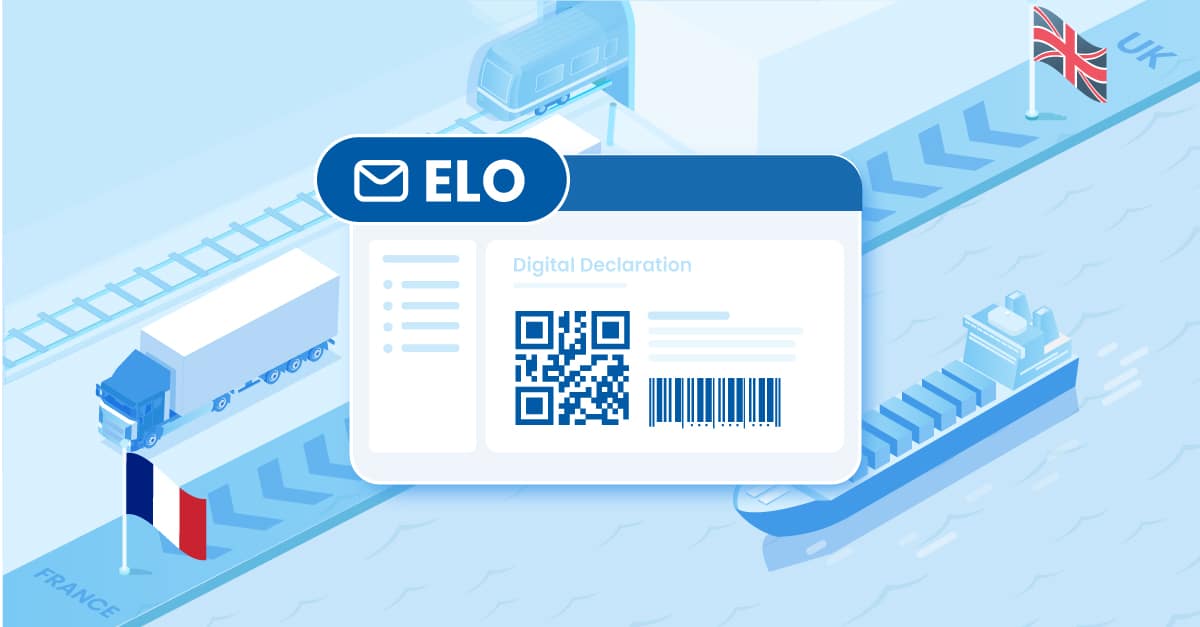
The Enveloppe Logistique Obligatoire (ELO), or “obligatory logistics envelope”, is a digital pass used by French Customs (DGDDI) at the post-Brexit Smart Border.
It consolidates the customs and security data attached to a single vehicle into one scannable barcode. This includes:
- export and import declarations
- transit documents
- ENS references
- vehicle details
Available on a voluntary basis since 28 April 2025, the ELO became compulsory on 20 April 2026. Since then, every truck – loaded or empty – crossing between Great Britain and France at Calais, Dunkerque or the Channel Tunnel must present a valid ELO at check-in, in both directions. Without it, the vehicle is refused boarding.
In effect, the ELO is France’s counterpart to the UK’s Goods Movement Reference (GMR), the barcode generated through the Goods Vehicle Movement Service (GVMS).
How does ICS2 fit into the picture?
The ELO does not replace customs declarations; it bundles them. Its foundation is ICS2, the EU’s Import Control System for advance safety and security data.
Each ELO must contain at least one Entry Summary Declaration (ENS) – the pre-arrival data set that lets customs run a risk assessment – and that ENS has to be filed through ICS2 before the envelope can be created.
Two ICS2 milestones matter here:
- Since 3 February 2026: ICS2 runs solely on its version 3 messaging; the older format has been withdrawn.
- For road movements: the ENS must be accepted at least one hour before the vehicle reaches the EU border.
A rejected or late ENS means no valid ELO, and no crossing.
What changes for parcels under the Windsor Framework?
Parcels moving from Great Britain to Northern Ireland follow the Windsor Framework arrangements, in force for all carriers since 1 May 2025. Movements run through two lanes:
- Green lane (UK Internal Market lane): for goods “not at risk” of entering the EU. Business-to-business consignments generally need a valid UK Internal Market Scheme (UKIMS) authorisation to use it; consumer parcels can move under the UK Carrier Scheme, where the carrier shares standard commercial data with HMRC.
- Red lane: full customs processes and duties apply. This is where B2B consignments default without UKIMS.
A year on, the recurring problem is data quality. Imprecise descriptions such as “gifts” or “parts” are being rejected, and HMRC has increased spot checks.
What should logistics and customs teams do now?
The common thread is preparation before the goods move. In practice, that means:
- accurate and complete commodity and consignment data
- clear ownership of who files the ENS and creates the ELO
- the right authorisations – such as UKIMS for relevant NI movements – in place ahead of time rather than at the border
How Gerlach supports you
Customs is all we do. Whether you need ENS filing through ICS2, an ELO created for a Channel crossing, or support with UKIMS and Windsor Framework parcel movements, our specialists keep your declarations accurate and your goods moving.
As a neutral customs broker – independent of any carrier – with more than 140 years of customs experience and over 1,000 experts across 27 countries, we help you stay compliant on every GB–EU and GB–NI lane.