
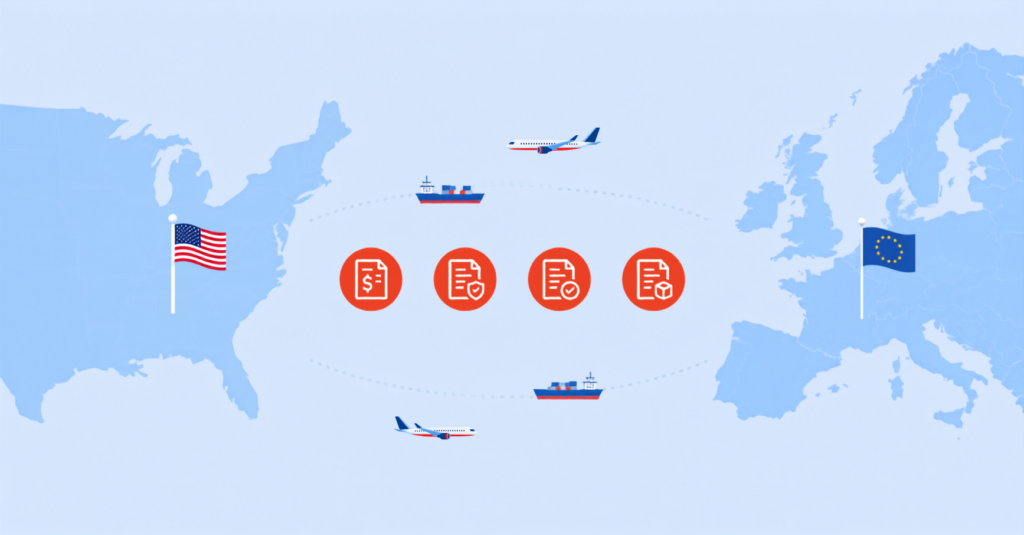
What are the changes in the EU–US trade?
Three developments explain most of the friction companies are currently experiencing.
1. Rules are changing faster than planning cycles
Both the EU and the United States have adjusted duties, origin requirements and procedures repeatedly over the past year. Customs planning has to be continuous rather than an annual exercise.
2. Origin has become a procurement topic
Since 1 July 2026, companies claiming the adjusted EU duties on US-originating goods must demonstrate non-preferential origin and direct transport to the EU. Neither is established by a statement on the commercial invoice alone, so the evidence has to be agreed with suppliers before goods ship. Origin management has effectively moved out of the customs department and into procurement.
3. Poor data now carries a price
With the US de minimis exemption removed, consignments that once moved with minimal formality require a full declaration. Vague product descriptions, outdated commodity codes and incomplete documentation translate directly into holds and cost.
Where do companies lose time and money?
Trade disruption makes the headlines, but the larger hidden cost usually comes from routine inefficiencies:
- incomplete or insufficient proof of origin
- incorrect or undocumented customs valuation
- poor master data quality
- unclear allocation of liability between importer and customs representative
Valuation deserves particular attention: assists, licence fees and retrospective transfer pricing adjustments are rarely visible on an invoice, and every increase in a duty rate multiplies the cost of getting the value wrong.
So does liability. Where a customs representative acts in indirect representation, it becomes a debtor for the customs debt alongside the importer, so an origin claim that cannot be substantiated becomes a shared exposure.
What does proactive customs management look like?
The answer is not more customs staff. It is better data, available earlier, and a few measurements that make performance visible. Greg Nichols, SVP Customs Solutions at DHL Global Forwarding, describes three areas where this pays off in this short clip.
1. Treat customs data as master data
Classification, origin and valuation should be decided once per product and documented, not reconstructed for each shipment. Held centrally, they make it possible to identify affected products and suppliers within hours of a rule change.
2. Understand duty exposure before goods move
Assessing duty during sourcing rather than after clearance gives real control over landed cost. It also surfaces preferential treatment a company is entitled to but has never claimed, usually because the supporting data was incomplete.
3. Measure customs performance
Clearance time, hold rate, amendment rate and duty paid against duty due are all measurable. The numbers typically show that companies moving comparable goods through the same port clear at very different speeds, and that the causes sit upstream in supplier data rather than at the border.
How does customs become a supply chain advantage?
Where customs is predictable, the benefits are felt well beyond the declaration:
- faster and more reliable product flows
- planning that holds because clearance windows are known
- tighter control of landed cost
- lower compliance and audit risk
- the ability to respond to policy change in days rather than months
The aim is not to remove customs complexity, but to stop it producing operational surprises.
Join the discussion in Chicago
If you have a presence in North America, DHL is hosting the TradeConnect Summit 2026 on 16 September at the DHL Innovation Center in Chicago, bringing together trade, customs, procurement and supply chain leaders to explore this shift from compliance burden to supply chain advantage.
If you would like to review your EU–US customs flows before then, our specialists are available to help. Gerlach has focused on customs and nothing else for more than 140 years, with over 1,000 experts across 27 countries and no ties to any carrier or freight forwarder.