Key takeaways
- A product’s name does not determine its HS code – its function, design and use do, read against the legal notes of the tariff.
- A customs audit finding is not automatically the final word: with solid evidence, it can be challenged and then secured with a Binding Tariff Information decision.
- For most companies, a small number of SKUs drives most of the duty bill, which is where a classification review delivers the greatest return.
How did one product end up costing €800,000?
The three audits had different findings. But once I followed the money, one product stood out above everything else.
– Three audits, one starting point
I always start with duty spend, because it shows where a classification error costs the most. Process gaps matter, but money tells you where to look first.
– The highest-duty SKU
In Ireland, the audit had resulted in €800,000 in fines across a number of customs issues. When I followed the duty spend, however, one product stood out: our highest-duty SKU.
The company hadn’t declared it as a valve. Customs disagreed: this is a valve, you’ve classified it wrong, fix it.
– Why nobody questioned it
Because everything seemed to confirm it. The description said valve. It looked like a valve. The engineers who designed it called it a valve. And now customs said so too.
There was also pressure to close the audit. This particular branch had been audited five years in a row and had failed each time, without addressing the issues identified in previous audits. The priority was to close the findings and move forward, so nobody stopped to question whether the classification itself was right.
So the company reclassified the product, paid, and moved on. From then on, that item carried 2.2% duty.
What was the product really?
I didn’t stop at the description. A product description is a summary – often written by someone who never had to think about customs.
– Engineers, supplier, customer
I spoke to the engineering team, the supplier and our customer. Then I read the chapter notes and explanatory notes – the legally binding notes and official guidance behind the tariff codes that decide how each heading is applied.
Here’s what the product actually did. During a medical procedure, it let blood flow in and out, and it let the physician pass instruments in and out. It was built for one medical device and nothing else.
– What the tariff means by “valve”
It was called a valve. It wasn’t one – not in the way the tariff uses the word.
Heading 8481 covers taps, cocks, valves and similar appliances for pipes, boiler shells, tanks, vats or the like. In other words: devices that control flow through pipework and vessels. Our product did none of that.
The distinction matters more than it might seem. Under Note 2(a) to Chapter 90, a part that is itself covered by a Chapter 84 heading stays in that heading – even if it is only ever used in a medical device. So “it’s a part of a medical device” would not have been enough on its own. The decisive point was that the product never fell within heading 8481 in the first place.
– A working part of a medical device
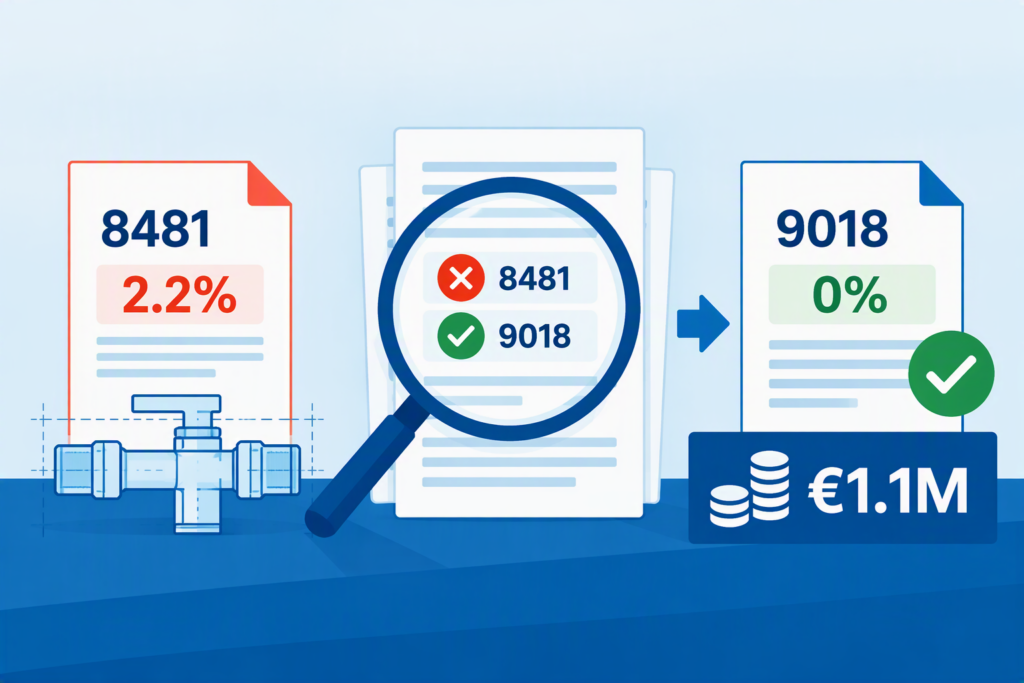
Once the valve argument fell away, the product could be classified with the device it was made for. Instead of heading 8481, which covers taps, cocks, valves and similar appliances, it fell under heading 9018, covering instruments and appliances used in medical sciences. We went from 2.2% duty to 0%.
How did 2.2% become 0% – and €1.1 million come back?
Knowing the right classification is one thing. Making it stick and getting the money back are two further steps – and they work differently.
– Locking it in with Binding Tariff Information
We applied for a Binding Tariff Information (BTI) decision – customs’ official, written decision on how a product is classified – and got it. Customs confirmed our classification in writing. That’s as settled as it gets.
In the EU, a BTI is valid for three years and binds every EU customs authority as well as the holder. It does not apply retroactively, though. A BTI secures your future imports – it doesn’t reopen past ones.
– Recovering the overpaid duty
I then reviewed all the customs entries on which the company had paid duty over the previous three years. That review identified not only the valve, but two other parts that had also been misclassified.
We claimed back the duty that had been overpaid on those products and recovered €1.1 million in total. Not a credit, and not a saving on paper. A refund paid into our bank account.
– The case at a glance
| Before | After | |
| Classification | Heading 8481 – valve | Heading 9018.90.8400 – part of a medical device |
| Duty rate | 2.2% | 0% |
| Legal certainty | Audit finding | BTI decision, valid for three years |
| Financial result | Duty paid on misclassified products | €1.1 million refunded |
What should importers learn from the valve case?
The product was specific, but the lessons apply to almost any company that imports goods at scale.
– Lesson 1: Don’t trust the name – know the product
The invoice said valve. The engineers said valve. But the name was misleading, and accepting it without questioning the product’s actual function led to the wrong classification.
Forget what it’s called. Ask instead:
- What does it do?
- How does it work?
- Why is there a layer of paint on it?
- Why is it curved?
- What is it part of?
Your engineers know how it works. Your supplier knows how it’s made. Your customer knows how it’s used. Ask all three.
– Lesson 2: Customs isn’t always right
Customs officers are good at their jobs. But they’re often working from the same description you gave them, under time pressure, across thousands of products.
An audit finding isn’t automatically the final word. Every customs decision in the EU can be appealed – in Ireland, for example, first to Revenue within 30 days, then to the independent Tax Appeals Commission. Procedures and deadlines differ from country to country. If you have the evidence, challenge it. And when you win, lock it in with a binding ruling.
– Lesson 3: Know where your duty goes
For most companies, a small number of SKUs drives most of the duty bill. That’s where a classification error costs the most, whichever way it runs: overpaying for years, or underpaying until the next audit catches it.
How do you check your top 20 duty SKUs?
This is the method I use. It takes little effort compared with what it can return.
- Pull duty spend by SKU and take the top 20: These typically account for most of your duty spend.
- Check every classification from scratch: Work through the chapter notes and explanatory notes – don’t simply confirm last year’s code.
- Talk to engineering, your supplier and your customer: Each knows something about the product that the description doesn’t.
- Consider a BTI where there is ambiguity: If the correct classification is unclear or open to interpretation, a Binding Tariff Information decision can provide certainty. It isn’t necessary for every classification.
- Check the repayment window: If you find you’ve overpaid, a repayment claim in the EU generally has to be made within three years.
- Do it now – not after your next audit: After that, review every 6 to 12 months. If volume on an item is about to jump, check it sooner. More volume means a bigger error.
How can Gerlach support your tariff classification review?
If you don’t know what your top 20 duty SKUs are, or when they were last properly checked, reach out.
Gerlach has focused solely on customs for more than 140 years. With more than 1,000 customs experts in 27 countries and as a carrier-independent provider, we help you review your classifications, prepare BTI applications and handle customs processes compliantly – so you can focus on your core business.