Key takeaways
- Article 23 allows businesses to defer Dutch import VAT.
- Import VAT is not paid upfront during the customs clearance process.
- Cash flow improves because VAT is reported through the periodic VAT return.
- It is particularly relevant for frequent importers and businesses with limited liquidity.
- For foreign companies, the setup depends on whether general or limited fiscal representation is used.
What is the Article 23 licence?
The Article 23 licence is a permit that allows businesses to defer import VAT when goods are imported into the Netherlands.
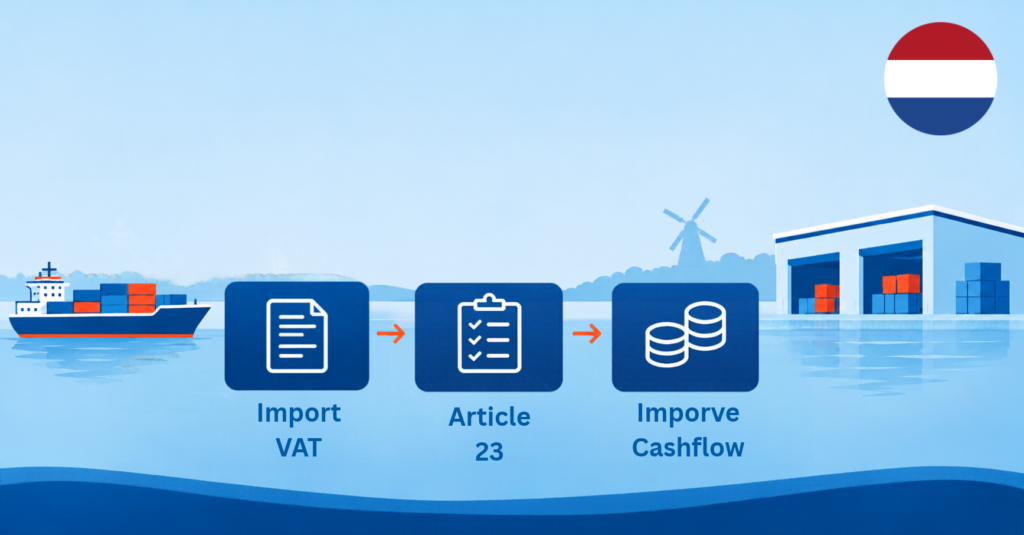
Instead of paying VAT immediately during the customs clearance process, the VAT is reported in the periodic Dutch VAT return, where it can be deducted at the same time, resulting in a nil VAT position.
In simple terms, there is no upfront VAT payment and no need to apply for a refund.
How Article 23 works in practice
The process is operationally straightforward:
- Goods are imported into the Netherlands.
- Import VAT is not paid at customs.
- The taxable base and VAT amount are reported in section 4a of the periodic VAT return, on a monthly or quarterly basis.
- The same amounts are deducted in section 5b of the VAT return.
- The VAT impact is neutral from a cash flow perspective.
Import VAT: Without vs with Article 23
| Without Article 23 | With Article 23 |
|---|---|
| Import VAT is paid upfront at customs | Import VAT is handled through the VAT return |
| VAT needs to be recovered through a refund procedure | Payable and deductible VAT are offset immediately |
| Potential refund delays | No need to wait for a VAT refund |
| Negative short-term cash flow impact | Neutral cash flow position |
The cash flow benefit: Example
Consider a business importing EUR 1,000,000 worth of goods into the Netherlands every month.
Monthly imports: EUR 1,000,000
VAT rate: 21%, the standard rate in the Netherlands
Import VAT: EUR 210,000 per month
| Without Article 23 | With Article 23 |
|---|---|
| EUR 210,000 import VAT is paid at customs | EUR 0 import VAT is paid at import |
| The tax authorities retain the EUR 210,000 until the VAT refund is approved | EUR 210,000 is reported in section 4a and deducted in section 5b of the VAT return |
| Cash flow pressure occurs every month | Nil VAT position |
| EUR 210,000 is temporarily unavailable to the business | EUR 210,000 remains available for operations, stock or growth |
For a frequent importer, this can make a significant difference to working capital by avoiding repeated VAT pre-financing.
Who should consider Article 23?
Article 23 is particularly relevant for businesses that regularly import goods into the Netherlands and would otherwise need to pre-finance import VAT.
– High-volume importers
Repeated VAT pre-financing can place significant pressure on an importer’s cash flow.
– Distribution and logistics hubs
The Port of Rotterdam, – where we have an office – is one of the main entry points for goods arriving from outside the European Union.
For businesses importing through major logistics hubs, repeated import VAT pre-financing can have a significant impact on liquidity.
– Non-EU companies importing into the EU
The Article 23 licence avoids large VAT prepayments at the EU border.
– Companies under cash flow pressure
Article 23 can be particularly relevant in capital-intensive supply chains where working capital is important for day-to-day operations and growth.
When Article 23 may not be the right fit
– Low import volumes
For businesses with low import volumes, the administration may outweigh the benefit of holding the licence.
– Limited VAT compliance capability
Article 23 requires accurate and timely VAT reporting.
– No Dutch VAT structure
For foreign companies, the requirements depend on the type of fiscal representation. With general fiscal representation, the company uses its own Dutch VAT registration and Article 23 permit. With limited fiscal representation, the foreign company uses the fiscal representative’s VAT number and Article 23 permit.
Requirements for Article 23
Before applying, the business needs the appropriate Dutch VAT and customs setup in place. For foreign companies, the requirements depend on the type of fiscal representation.
- With general fiscal representation, the company uses its own Dutch VAT registration and Article 23 permit.
- With limited fiscal representation, the foreign company uses the fiscal representative’s VAT number and Article 23 permit.
The main requirements may therefore include:
- Dutch VAT registration
- an EORI number linked to the Dutch VAT number
- a local fiscal representative for companies not established in the Netherlands
The licence can be requested even if the company has not yet imported goods into the Netherlands.
How to apply for Article 23
Prerequisites (H3)
Before applying, the appropriate VAT, EORI and fiscal representation setup needs to be in place.
For foreign companies, the requirements depend on the type of fiscal representation:
- with general fiscal representation, the company uses its own Dutch VAT registration and Article 23 permit
- with limited fiscal representation, the foreign company uses the fiscal representative’s VAT number and Article 23 permit
- an EORI number must be linked to the relevant Dutch VAT number
The licence can be requested even if the company has not yet imported goods into the Netherlands.
Application process
The application process generally involves the following steps:
- Confirm that the required VAT, EORI and fiscal representation setup is in place.
- Prepare the Article 23 application where applicable.
- If imports are already taking place regularly, include supporting documents such as order confirmations, purchase invoices and/or import documents where relevant.
- Submit the application to the Dutch tax authorities by post.
- Await approval and confirmation.
The official processing time can be up to eight weeks. Through Gerlach, however, approval can often be obtained within a couple of weeks due to established direct contact with the relevant authorities.
No payment to the tax authorities is required, as both the Article 23 licence and the associated application procedure are free of charge.
When appointing a local representative for a foreign company, security must be provided, typically in the form of a cash deposit or bank guarantee.
Ongoing obligations
After approval, companies must:
- correctly declare postponed import VAT
- maintain clear customs and VAT records
- remain audit-ready at all times
- keep customs and VAT compliance aligned
Common mistakes to avoid
– Misunderstanding VAT reporting mechanics
The postponement granted by the licence shifts VAT to the VAT return. It is not a VAT exemption.
– Applying in the wrong country
The Article 23 licence applies only in the Netherlands. Goods imported into another EU Member State are subject to different VAT and customs rules.
– Poor coordination between customs and VAT
Poor coordination between customs and VAT, combined with an underestimation of the compliance effort, can create problems.
Data mismatches can trigger audits, so solid administration is essential.
Case study: Non-EU importer distributing through the Netherlands
– Situation
A non-EU company imported goods into the Netherlands every month for distribution across the EU.
VAT prepayments exceeded EUR 1 million annually, creating cash flow pressure.
– Solution
Article 23 was implemented alongside Belgian VAT registration and aligned customs procedures, managed by Gerlach.
– Result
- import VAT was no longer paid upfront
- cash flow improved immediately
- the import and VAT reporting process was managed directly by Gerlach
How Gerlach supports your Article 23 setup
Gerlach supports businesses with Article 23 applications, Dutch VAT registration, fiscal representation and the integration of VAT requirements into customs processes.
Our support can range from handling the Article 23 application as a standalone VAT solution to providing general or limited fiscal representation.
Where required, Article 23 can also be integrated into a fully managed customs clearance solution, helping keep VAT, customs processes and ongoing compliance aligned.
We can support with:
- assessing eligibility and business fit
- Dutch VAT registration
- general fiscal representation
- Article 23 applications
- aligning customs clearance with VAT reporting
- long-term compliance support
Contact Gerlach to assess whether Article 23 is the right solution for your import flows and to define the next steps.