Key takeaways
- EUDR applies to the specific products listed in Annex I, not to every product that contains one of the seven relevant commodities.
- The correct customs classification is the key to the check, and an “ex” in front of a code means that only part of that code is covered.
- Annex I changed on 18 September 2026, so only the current consolidated version of the regulation gives you a reliable answer.
Why “it’s made of wood ” is not sufficient?
The intuitive approach is to start with the raw material: if a product contains wood, rubber or cocoa, it must be covered. EUDR does not work that way.
– Seven commodities, one defined product list
EUDR names seven relevant commodities: cattle, cocoa, coffee, oil palm, rubber, soya and wood. They define the regulation’s focus, but not its scope. Scope is defined by Annex I of Regulation (EU) 2023/1115, which lists the relevant products by their customs codes. Only products listed there are subject to EUDR.
– Not listed means not in scope
A product made largely of wood can be outside EUDR if its customs code is not listed. Finland’s competent authority, for example, names a toy with wooden parts as not covered, because toys are not listed in Annex I.
At the same time, products you might not associate with deforestation – such as particle board or cartons – can be fully in scope.
How do you check whether your product is subject to EUDR?
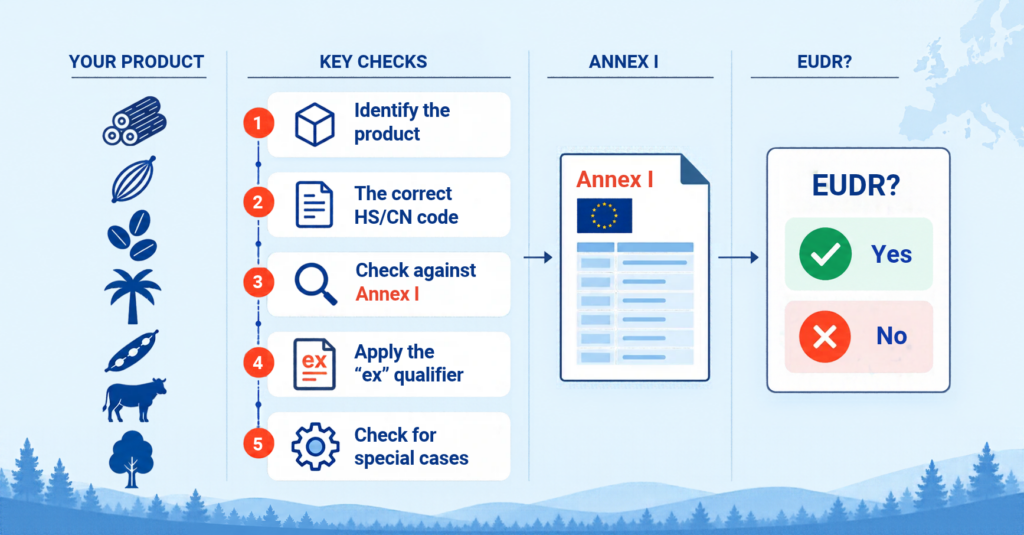
A reliable assessment follows five steps. Each builds on the previous one, and skipping one is the most common source of mistakes.
– Step 1: Identify the actual product
Start with what is physically imported, exported or placed on the market: a raw material, a semi-finished product, a finished good, a spare part or packaging? Descriptions such as “wooden goods” or “rubber parts” are too vague. You need the level of detail a customs declaration requires: material, function and degree of processing.
– Step 2: Establish the correct customs classification
Annex I identifies products by their Harmonised System (HS) and Combined Nomenclature (CN) codes. The CN code is the EU’s eight-digit extension of the international six-digit HS code.If the classification is wrong, the EUDR assessment will be wrong too – in either direction. Correct tariff classification is therefore not a formality, but the basis of your compliance decision.
– Step 3: Check the code against the current Annex I
Compare your product’s code with the current consolidated version of Annex I. The question is not “Is this wood?” but “Is this code listed?”
– Step 4: Read the “ex” qualifier
If an entry starts with “ex”, only part of the listed code is covered. The product description next to it tells you which part.
– Step 5: Check for special cases
Finally, check whether Annex I treats your product differently: packaging, composite products, waste, second-hand goods and samples.
What does this look like in practice?
The following products regularly appear in EU customs declarations and show how the five steps lead to a result.
| Product | CN code | Annex I entry | Assessment |
| Green coffee beans (not roasted, not decaffeinated) | 0901 11 00 | 0901 | Covered |
| Technically specified natural rubber | 4001 22 00 | ex 4001 | Covered |
| Particle board of wood, surface-covered with decorative plastic laminates | 4410 11 50 | ex 4410 | Covered (new goods) |
| Fitted kitchen units of wood | 9403 40 10 | ex 9403 40 | Covered (new goods) |
| Corrugated cartons, imported empty | 4819 10 00 | ex 48 | Covered as a product in its own right |
| Parts of aircraft seats, not of wood | 9401 99 10 | Not listed | Not covered |
Coffee is the simplest case: heading 0901 is listed without any qualifier, so all coffee under it is covered. Natural rubber shows that EUDR is not just about wood, and particle board shows that processed products are covered too – even when they have little in common with raw timber.
What does “ex” mean in Annex I?
The “ex” is easy to overlook. According to the EU legislator, it clarifies that products under an Annex I entry fall within scope “only in so far as they are produced using a relevant commodity”. The description next to the code can narrow the entry further – for example to certain materials or to new goods only. Seeing your heading in Annex I is therefore not enough.
– Seats: a heading that is only partly covered
Heading 9401 covers seats and seat parts of all materials. Annex I lists only six of its subheadings – all limited to seats or seat parts of wood, such as upholstered seats with wooden frames (ex 9401 61 00). Metal and plastic seats are not covered, and since September 2026, aircraft and motor vehicle seats are explicitly excluded.
Aircraft seat parts are a useful cautionary example. They are classified under 9401 99 10, which covers seat parts not made of wood. A screening tool matching at heading level may flag them as EUDR-relevant – yet this code has never been among the wooden seat parts listed in Annex I.
– Wooden furniture: “ex” can also exclude used goods
Not every “ex” limits the material. Fitted kitchen units of wood (9403 40 10) and wooden furniture parts (9403 91) are made of wood by definition. Here, the “ex” excludes used and second-hand products. New kitchen units from a manufacturer are covered; the same units traded second-hand are not.
– Natural rubber: “ex” limits the source
Heading 4001 also covers balata, gutta-percha and chicle. Annex I only applies to rubber from the Hevea brasiliensis /Para Rubber tree – other natural gums and synthetic rubber are not covered.
What about packaging, composite and recycled products?
Some products need a closer look because of their function or material. The following overview is not exhaustive, but it will help you recognise when a more detailed assessment is needed.
– Packaging: a product in its own right or packing for another product?
Paper and paperboard (ex 48) and wooden packing cases and pallets (ex 4415) are listed in Annex I. Since September 2026, Annex I itself defines when packaging is excluded.
Packaging used exclusively to support, protect or carry another product, and presented with that product, is not covered. If your goods arrive in cardboard boxes or on wooden pallets, the packaging is not subject to EUDR. Reusable packaging is excluded from the moment it is first used this way.
If you import or sell packaging as a product in its own right, it is covered. Empty corrugated cartons imported to pack your own goods later fall under ex 48.
– Composite products
For products made from several materials, the classification of the finished product decides. If its code is not listed in Annex I, it is not covered – even if it contains a relevant commodity. If it is listed, EUDR obligations relate to the relevant commodity covered by that entry.
– Waste, second-hand products and samples
EUDR does not apply to products made entirely from material that has completed its life cycle and would otherwise have been discarded as waste. If part of the product is made from new material, that part remains relevant. Many Annex I entries now also explicitly exclude waste, used and second-hand products.
Samples of negligible value used only to solicit orders are excluded too, as are goods used up or destroyed during testing.
Why must you check the current version of Annex I?
Commission Delegated Regulation (EU) 2026/2102 replaced Annex I with effect from 18 September 2026. Product lists compiled before that date may now be wrong.
– What has changed
Products removed from scope include cattle hides and leather, conveyor belts and other articles of vulcanised rubber, aircraft and motor vehicle seats, soya beans for sowing and most retreaded and used tyres.
Other products will be added from 30 December 2027, including soluble coffee (2101 11 00), frozen cattle tongues and a range of palm oil derivatives such as soap. For coffee importers, scope will then extend from beans to coffee extracts.
– Screening results are a starting point, not an answer
Automated screening against tariff codes helps identify potentially affected goods. However, it often matches at heading level and cannot read “ex” qualifiers or exclusions. Treat every hit as a prompt to check the current Annex I – not as a final answer.
How Gerlach supports your product assessment
Whether EUDR applies starts with a customs question: how is your product classified? As a customs specialist with more than 140 years of experience, more than 1,000 customs experts and a presence in 27 countries, Gerlach supports you with tariff classification and checking your products against the current Annex I – independently of your carrier.
Once you know which products are covered, the next question is what needs to go into the customs declaration.